 How time flies. 20 years since the inception of Bangarra Dance Theatre. The title, methinks, has licenced at least some of its almighty success, in that the word theatre allows that much more scope. Bangarra, we're reminded, in Fire - A Retrospective, has used every centimetre of that scope in its many, various and varied productions. (In Wiradjeri, Bangarra means 'to make fire'.)
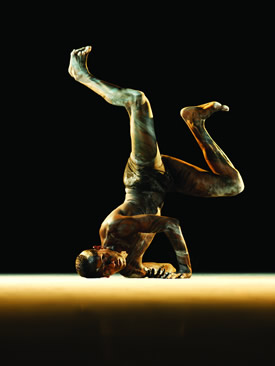
 There's no self-consciousness in traversing traditional dance; visually narrating a gritty piece on heroin addiction; corrupting the lord's prayer, in a provocative metaphorical work, pointing, in no uncertain terms, to 200 years of received horrors; a sublimely romantic aesthetic, in a contemporary 'pas de deux'; good-humoured sensuality in a slipping, sliding, sideways glance at mud-wrestling; abstract, conceptual mythological evocations.
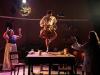
It's exuberant, unexpurgated, unafraid, edgy and bold. At the same time, it reflects the highest possible standards of athleticism, craft and choreography; the latter always erring on the side of elegant simplicity and cadence. Everything is executed, too, with production values second-to-none; breathtakingly flawless. There's probably no finer moment than at the very start: all fades to black; we see what might be seen as a supersized nest, a universal vagina, a cradle, constructed from branches, from which emerges, to our surprise, a man. Bangarra is born.
Fourteen dancers and guest artists bring the programme, which fittingly begins with an homage to Northeast Arnhemland, together. Bringing such stylistically disparate parts tinto a cohesive whole must have been a challenge, to say the least. But it's been achieved, in the manner of an exquisite patchwork quilt; a stream of consciousness, and conscience.
The even greater achievement, of course, is the survival, over two decades, of an all-indigenous dance theatre company; which parallels the survival of Australian indigenes, at large, over forty millennia, if not a much longer span. From humble beginnings as national indigenous dance school, NAISDA, and in defiant response to the absence of opportunities for 'blackfella' dancers and choreographers, Bangarra came into being, breaking ground, by critical consensus, incredibly early in its life, with Ochres, in 1995, which, though inspired by traditional forms, pushed the envelope into new and modern territory.
While not going out of its way to politicise, polarise, or polemicise, neither has Bangarra resiled from grappling with social issues. Artistic director, Stephen Page, has spoken of 'art, and dance, as medicine'; presumably to heal some of the still open wounds inflicted by white Australia. in such a sustained and unrelenting barrage.
Yet you'll never be weighed down or have the finger wagged too sharply: Page and co temper outrage with beauty; physical, visual and musical. The choreography of Page, Frances Rings and Bernadette Walong-Sene finds no known parallel, for mine, in contemporary dance. Always inventive, but never yielding to avant-garde affectations or pretensions, there is real self-assurance in their brand of body music; often 'sung' in choruses, with melody, rhythm, grace, dignity and still with ample room for solo individuations.
Composers David Page and Steve Francis overlay and underpin, with their indispensible aural dimension; as with the dance itself, a painstaking pastiche of the traditional, orchestral, operatic, narrative, chilled, stirred and shaken.
I've already alluded to Peter England's extraordinary set designs, which are complemented impeccably by Jennifer Irwin's costumes. Film editor Rochelle Oshlack has skillfully interpolated nostalgic, photographic reminiscences and other material, projected in unexpected ways; onto the bodies of the dancers, for example. Nor can one underplay the contributions of an arsenal of talented lighting designers, in Jo Mercurio, Mark Howett, Karen Norris, Trudy Dalgleish and Nick Schlieper. And less glamourous, but vital, aspects are in equally expert and uncompromising hands: cultural consultants, Djakapurra Munyarryun, Kathy Balngaygnu Marika, Jensen Warusam and Isaac Waia; Aaron Beach's, as production manager; Neil Fisher's tight-knit technical management; Kate Williams' blemish-free stage management; and a host more. And then there are the dancers: Sidney Saltner, Elma Kris, Yolande Brown, Patrick Thaiday, Deborah Brown, Jhuny-Boy Borja, Tara Gower, Leonard Mickelo, Waangenga Blanco, Jasmin Sheppard, Daniel Riley McKinley, Katina Olsen, Perun Bonser & Ella Havelka.
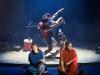
The first works are traditional, from Yirrkala, featuring special guest performer Kathy Balngaygnu Marika and the full ensemble. Morning Star (Banumbirr); Bush Wallaby (Dhum Dhum); Wind (Wata); Brolga (Gudurrku). The last was woven into the company's 2001 production, Corroboree, which took out the following year's Helpmann, for best choreography. If there are songlines, perhaps there are dancelines, which wend their way from prehistoric times, all the way to the Drama Theatre. The result is hauntingly transcendent; transcending time and cultures.
There's much else from Corroboree, to follow, including Deborah Brown's solo, in Dream.
1995's Ochres sports four key (indeed, seminal), colourful works: White; Red; Black; Yellow. These explore the myriad dimensions and significances of 'paint-up': physical, spiritual, mystical and medicinal. Its uninhibited, body-lingual free expression is still vital and refreshing, a decade-and-a-half after its debut.
Issues are confronted head-on, drawing on productions as distinctive as Skin & Walkabout. The first picked up a swag of awards, thanks to excerpts like Dingo. This production signified Stephen Page's engagement with the ties that bind: kinship; family; obligation; respect; responsibility. It is grand, but in no way grandiose: on the contrary, it achieves high ideals and aspirations with deft and devastating simplicity. And is pregnant with insight into the nature of black community.
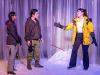
2003's Walkabout was and remains a confronting, uncompromising narrative which runs the gauntlet of travesties perpetrated against indigenes, from missions, to station and urban ghettos.
And that's the tip of the iceberg: we've barely touched the sides of the first act!
None of this, methinks, would get off the ground without the driving force that is the Page boys. Wherever else Bangarra goes, whatever else it does, in the next twenty years and more, will pivot on that legacy. Given this much energy, passion, vigour & rigour, so consistently applied, I can't envisage a day when Bangarra could possible fall short of the countless accolades, awards, plaudits and kudos it's earned to date. Fire got a rousing reception, including ovation, at the afternoon performance I attended. The audience would hardly let the company leave the stage. I hope they never do. Invigorated. Invigorating!
Bangarra Dance Theatre presents
FIRE - A RETROSPECTIVE
Venue: Sydney Opera House
Dates: 28 August - 26 September
Bookings: 02 9250 7777 | www.sydneyoperahouse.com
TOUR DATES
Wollongong – 20-22 August
Brisbane – 7-10 October
Newcastle – 30-31 October
Melbourne – 6-14 November
Canberra – 20-21 November